What is nanotechnology?
First, a word of caution
Truly revolutionary nanotech products, materials and applications, such as nanorobotics, are years in the future (some say only a few years; some say many years). What qualifies as "nanotechnology" today is basic research and development that is happening in laboratories all over the world.
"Nanotech" products that are on the market today are mostly gradually improved products (using evolutionary nanotechnology) where some form of nano-enabled material (such as carbon nanotubes, nanocomposite structures or nanoparticles of a particular substance) or nanotech process (e.g. nanopatterning or quantum dots for medical imaging) is used in the manufacturing process.
In their ongoing quest to improve existing products by creating smaller components and better performance materials, all at a lower cost, the number of companies that will manufacture "nanoproducts" (by this definition) will grow very fast and soon make up the majority of all companies across many industries.
Evolutionary nanotechnology should therefore be viewed as a process that gradually will affect most companies and industries.
Definition of nano technology
So what exactly is nanotechnology? One of the problems facing this technology is the confusion about how to define nanotechnology. Most revolve around the study and control of phenomena and materials at length scales below 100 nm and quite often they make a comparison with a human hair, which is about 80,000 nm wide.
Some definitions include a reference to molecular nanotechnology systems and devices and 'purists' argue that any definition needs to include a reference to "functional systems". The inaugural issue of Nature Nanotechnology asked 13 researchers from different areas what nanotechnology means to them and the responses, from enthusiastic to sceptical, reflect a variety of perspectives.
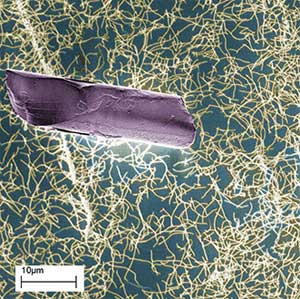
Human hair fragment and a network of single-walled carbon nanotubes (Image: Jirka Cech)
It seems that a size limitation to the 1-100 nm range, the area where size-dependant quantum effects come to bear, would exclude numerous materials and devices, especially in the pharmaceutical area, and some experts caution against a rigid definition based on a sub-100 nm size.
As small as a nanometer is, it's still large compared to the atomic scale. An atom has a diameter of about 0.1 nm. An atom's nucleus is much smaller -- about 0.00001 nm. Atoms are the building blocks for all matter in our universe. You and everything around you are made of atoms. Nature has perfected the science of manufacturing matter molecularly.
For instance, our bodies are assembled in a specific manner from millions of living cells. Cells are nature's nanomachines. At the atomic scale, elements are at their most basic level. On the nanoscale, we can potentially put these atoms together to make almost anything.
lecture called "Small Wonders:The World of Nanoscience," Nobel Prize winner Dr. Horst Störmer said that the nanoscale is more interesting than the atomic scale because the nanoscale is the first point where we can assemble something -- it's not until we start putting atoms together that we can make anything useful.
Some pic of nano material
Reference: nanowerk.com , science stuff work
Good bye . Have a nice day


No comments:
Post a Comment